Manufacturing
training
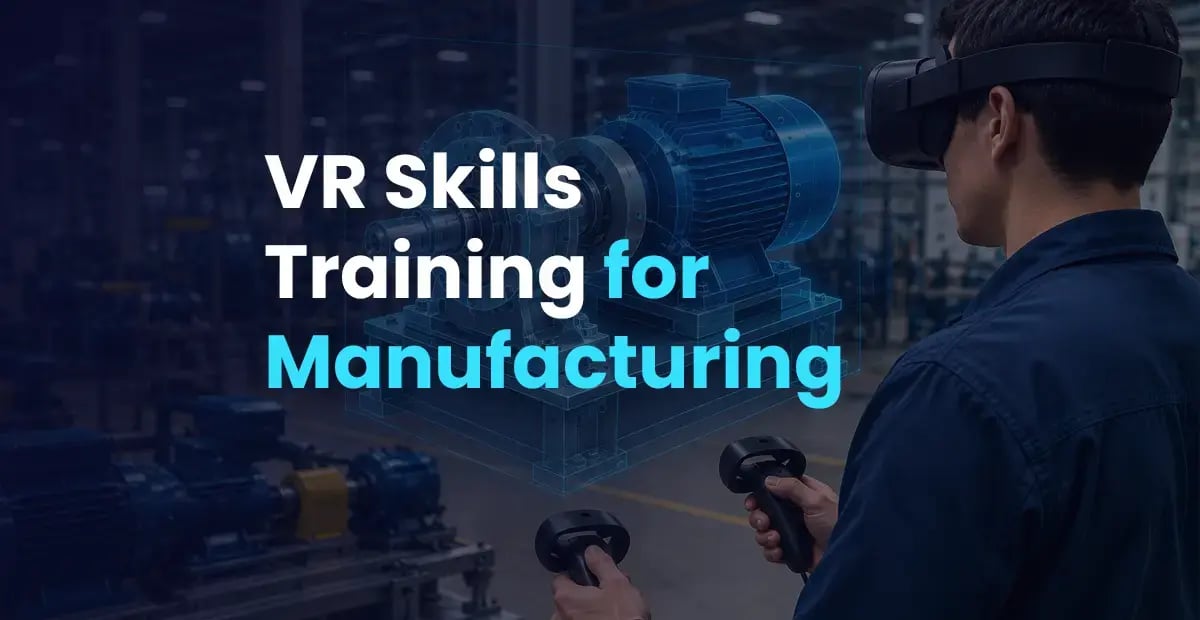

Manufacturing is the industry where the cost of inadequate training is most immediate and most measurable. An untrained operator touching the wrong control damages equipment worth hundreds of thousands of dollars. An undertrained maintenance technician skipping a lockout step becomes a lost-time injury statistic. A new hire who takes ten weeks to reach competency instead of six is a direct production cost.
Virtual reality skills training for manufacturing addresses all three problems simultaneously — by placing operators, technicians, and new hires inside photorealistic simulations of your actual facility before they ever set foot on the production floor.
This page covers the specific training scenarios VR enables in manufacturing environments, the measurable outcomes US manufacturers are achieving, and the compliance and integration requirements your L&D team will need to plan for.
|
42%
faster onboarding to production-floor competency
|
35%
reduction in equipment error rates in year one
|
|
28%
fewer OSHA recordable incidents after VR safety induction
|
94%
learner completion rate across all deployed modules
|
Manufacturing L&D and HSE leaders consistently report the same cluster of problems — not because they’re running bad programs, but because the formats available to them are structurally inadequate for what the factory floor demands.
|
⛔
On-equipment training is too risky
New operators on live production equipment create safety exposure, production risk, and liability. Most plants cap on-equipment supervised training sessions — which means many operators reach certification with insufficient hands-on practice.
|
🕒
Onboarding is too slow and too expensive
The average manufacturing onboarding program runs 8–12 weeks. During that period, the new hire produces at a fraction of full capacity. For a facility hiring 100 operators per year, the lost productive output is significant — and traditional classroom programs can’t compress the timeline without compromising safety.
|
|
👥
High turnover resets the training cost
US manufacturing turnover averages 30–40% annually. Every departing operator takes the training investment with them. With classroom and on-equipment programs, the cost per hire is fixed regardless of tenure — making high-turnover facilities chronically over-spend on training relative to productive output.
|
🌎
Multi-site consistency is nearly impossible
A manufacturer with plants in Ohio, Texas, and Georgia cannot guarantee that the safety induction delivered by the trainer in Dayton is equivalent to the one in Houston. Trainer quality variance, equipment differences, and language gaps produce inconsistent workforce competency across sites.
|
Our manufacturing VR training programs cover the full range of production floor skill requirements — from day-one safety induction through advanced equipment certification. Every scenario is built around your actual equipment, your layout, and your procedures — not generic factory templates. See how this approach compares to other AR VR development partners for manufacturing training in our 2026 ranking.
The following outcome data is drawn from Smacar / Yaksha VT manufacturing client deployments across the US and APAC. All figures represent year-two performance compared to year-zero baseline — allowing for the implementation and ramp-up period in year one.
| Outcome metric | Before VR | After VR (Yr 2) | Change |
|---|---|---|---|
| Avg. onboarding duration | 9.2 weeks | 5.3 weeks | ↓ 42% |
| Equipment error rate | Baseline | 35% lower | ↓ 35% |
| OSHA recordable incidents | 11 / year | 7–8 / year | ↓ 28% |
| Training module completion rate | 68% | 94% | ↑ 38 pts |
| 30-day knowledge retention | 32% | 76% | ↑ 44 pts |
| Annual training cost per learner | $1,240 | $520 | ↓ 58% |
A common concern from manufacturing IT and L&D teams is that VR training will require a parallel system. It does not. Every module we build exports completion records, assessment scores, and interaction data via SCORM 1.2, SCORM 2004, or xAPI — compatible with every major LMS used in US manufacturing environments.
|
✅ LMS integration
SAP SuccessFactors, Cornerstone, Workday Learning, Moodle, TalentLMS, and all SCORM/xAPI-compatible platforms. Learner completion records appear in your existing compliance dashboards — no new reporting system needed.
|
✅ Device management
Meta Quest headsets enrolled via MDM (ArborXR, ManageXR, or Microsoft Intune). Content pushes silently over Wi-Fi. IT manages the fleet through the same console they use for other devices — no specialized VR IT skills required.
|
|
✅ Multilingual delivery
US manufacturing workforces are diverse. All modules support audio narration, UI labels, and assessment questions in English, Spanish, Portuguese, Vietnamese, Mandarin, and 9 additional languages. Same module, same content, same certification standard.
|
✅ Multi-site consistency
Ship a headset fleet to each plant. Every operator across every facility runs the same simulation, receives the same instruction, and is assessed against the same standard. Quality variance between sites drops to zero.
|
Every manufacturing VR training module maps directly to the applicable OSHA standard and, where required, ISO 45001 clause. Completion records are timestamped, learner-attributed, and audit-ready — replacing manual sign-in sheets and paper completion records with a digital audit trail that satisfies OSHA inspection requirements.
| Training module | OSHA standard | ISO 45001 |
|---|---|---|
| Lockout / tagout | 29 CFR 1910.147 | Clause 8.1.2 |
| Forklift operation | 29 CFR 1910.178 | Clause 8.1.2 |
| Hazard communication | 29 CFR 1910.1200 | Clause 8.2 |
| Machine guarding | 29 CFR 1910.212 | Clause 8.1.2 |
| Emergency action plans | 29 CFR 1910.38 | Clause 8.2 |
| PPE selection & use | 29 CFR 1910.132 | Clause 8.1.2 |
The following case data is drawn from Yaksha VT client deployments. Financial figures and outcome metrics are representative of results achieved — exact values are client-confidential where noted.
A tier-1 auto components supplier with three US plants was facing a compound problem: 850 annual operator hires, a 9-week onboarding program, 30–35% annual turnover, and OSHA recordable incident rates trending upward. Classroom safety induction ran 5 days per new hire, with on-equipment certification requiring a further 4–6 weeks of supervised floor time. Pulling experienced operators off the line to supervise new hires was a measurable production cost the business could no longer absorb.
|
Before VR (Year 0)
Onboarding duration9.2 weeks
Annual training cost$680,000
OSHA recordables / yr11
Module completion rate68%
|
After VR (Year 2)
Onboarding duration5.3 weeks
Annual training cost$290,000
OSHA recordables / yr7
Module completion rate94%
|
Yaksha VT partnered with the HSE department of a leading European EPC contractor to develop an immersive Hull Safety Training program using virtual reality. The client required a training solution that could simulate high-exposure marine safety scenarios — confined spaces, structural hazards, and emergency evacuation procedures — in a risk-free environment, ahead of live vessel operations.
A key element of this engagement was the upskilling of the client’s own internal development team in Unity — embedding VR content creation capability directly within the client organisation so they could iterate and expand the training library independently after delivery.
|
Kumaragurubaran
XR Architect — VR system integration lead
|
Durairaj
VR Development Lead — environment & simulation
|
|
Deena Dayalan
XR R&D Specialist — training scenario design
|
Raj Mohan
UI/UX Designer — learner interface & experience
|
|
Subhash
3D CAD Optimisation — Pixyz pipeline for Meta Quest
|
Sabarivasan
Project Coordinator — delivery & client liaison
|
We’ll run a simulation built around your industry — equipment operation, LOTO, forklift, or assembly — and show you the analytics dashboard with real deployment data from comparable manufacturers. 30 minutes. No commitment.