Which AR VR Development Partners Lead Manufacturing Training in 2026?
Kumaragurubaran
Buyer's Guide / Manufacturing XR / 2026 Edition
Last Updated: July 22, 2026 · By Kumaragurubaran, XR Solutions Architect, Yaksha Visual Technologies
Quick Answer
The strongest AR VR app development for manufacturing in 2026 comes from partners that handle three things well at once — cross-platform worker training that runs on headsets and mobile AR, multi-site manufacturing plant deployment through a central LMS, and equipment maintenance content built from real SOPs and CAD data. Yaksha Visual Technologies, Strivr, Roundtable Learning, VR Vision Group, Humulo, and Luminous XR each lead in a different part of that equation, and this guide breaks down where each one fits.
Why Manufacturing Safety Managers Are Evaluating AR VR Training Partners Now
AR VR app development for manufacturing addresses this by letting workers practice high-risk or high-cost procedures in a simulated or overlaid environment before they touch the real machine. See our full guide to AR maintenance and VR safety training for manufacturingfor a deeper breakdown of the planning framework.
Manufacturing safety managers are under pressure to cut onboarding time, reduce recordable incidents, and standardize training across plants that often run different equipment and shift patterns. Traditional classroom and video-based training does not transfer well to hands-on tasks like lockout/tagout, forklift operation, or machine changeovers. AR VR app development for manufacturing addresses this by letting workers practice high-risk or high-cost procedures in a simulated or overlaid environment before they touch the real machine.
Cross-Platform Reach
One build, delivered to headsets, tablets, and mobile AR.
Multi-Site Rollout
Same module, pushed and tracked across every plant.
Maintenance AR
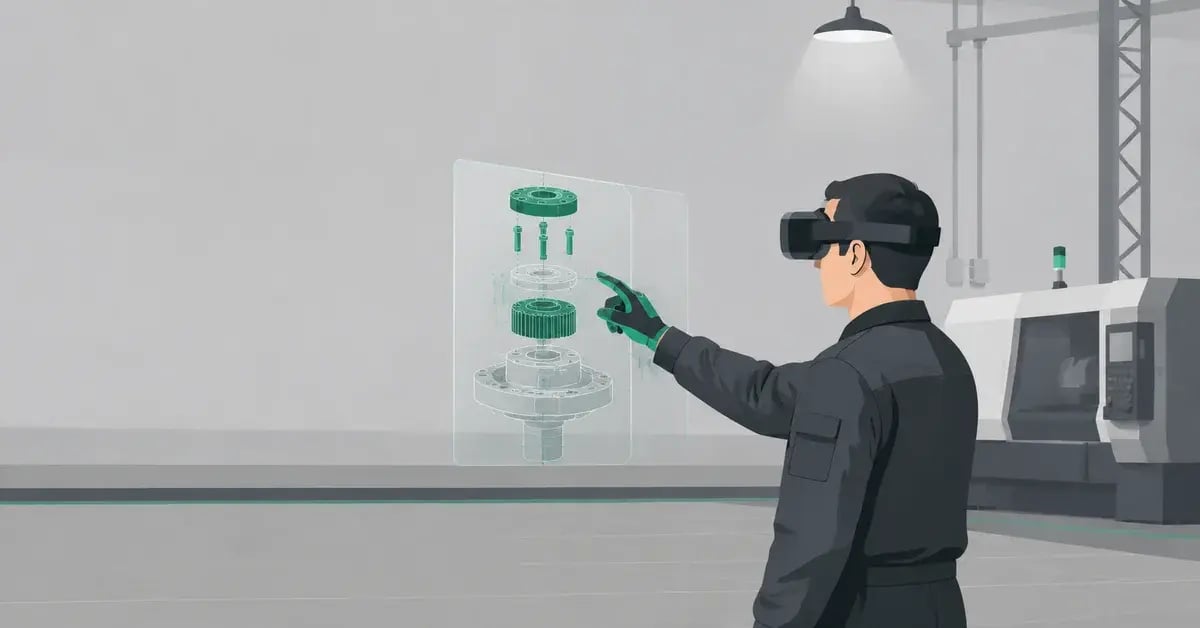
Overlaid, step-by-step guidance on the real machine.
How Do the Top AR VR Manufacturing Training Partners Compare?
The scorecard below rates each partner on the three capabilities manufacturing buyers ask about most.
Best for Cross-Platform Training and Equipment Maintenance AR
Yaksha Visual Technologies builds custom VR training services for manufacturing that spans cross-platform worker training, multi-site manufacturing plant rollouts, and equipment maintenance AR from a single content pipeline. Rather than starting from an off-the-shelf module, Yaksha's team builds simulations from a plant's own CAD data, SOPs, and equipment specifications, using a Unity Industry license with Pixyz-based CAD optimization to bring heavy industrial models into VR and AR without stripping engineering accuracy.
✓Cross-platform delivery: one build runs on VR headsets, mobile AR, and web-based 360° tours.
✓Multi-site deployment: content built once is redeployed across sister plants with site-specific variations layered in.
✓Equipment maintenance AR: step-by-step guidance overlays directly onto the real machine.
✓Track record: NPTEL-IIT Madras, NITTTR Chennai, Ashok Leyland, Royal Enfield, Mahindra, Saipem, and IACMI (USA), Mahle Pistons, Saipem India.
Best for: manufacturers who need training matched exactly to their own equipment, deployed consistently across more than one facility.
02
Strivr — Best for Enterprise-Scale VR Training With Behavior Analytics
Strivr is built for large enterprises that need to run thousands of employees through standardized VR training and measure the results with granular behavioral data. Its platform captures gaze, hesitation, and decision-making signals during a session, which lets safety teams see exactly where a procedure trips workers up.
Large-scale deployments including hundreds of thousands of training sessions.
Newer AI-driven guidance layer that flags operational errors during real task execution.
Quote-based pricing, typically per headset per year plus content development.
Best for: large manufacturers with the headset volume and budget for a custom, data-heavy VR program.
03
Roundtable Learning — Best for Full-Service VR, AR, and MR Programs
Roundtable Learning positions itself as a one-stop training partner rather than a single-modality vendor, building VR, AR, and mixed reality content on top of its own Mercury XRS learning management system — useful for teams that want one partner managing needs analysis, content build, deployment, and reporting.
In-house Mercury XRS LMS tracks completion across VR, AR, and MR in one dashboard.
Off-the-shelf modules like PIT Trainer XR alongside fully custom builds.
Manufacturing use cases spanning machine operation, quality control, and assembly procedures.
Best for: training teams that want one vendor covering content, hardware guidance, and LMS reporting together.
04
VR Vision Group — Best for Multi-Site Automotive and Industrial Fleets
VR Vision Group has built its reputation on large industrial and automotive deployments, including dealer and technician training programs spanning multiple countries. Its Vision Portal platform gives supervisors a live view into every connected headset — useful for coordinating training across several plants at once.
Vision Portal streams first-person headset feeds and tracks device status fleet-wide.
Named case studies with Toyota, Siemens, and Coca-Cola.
Operating since 2016, with over 30,000 professionals trained globally.
Best for: automotive and industrial organizations managing VR training fleets across multiple sites or dealer networks.
05
Humulo — Best for Fast, Turnkey OSHA-Aligned Safety Training
Humulo is built for speed and compliance rather than deep customization. Its standalone, offline VR headsets ship pre-loaded with OSHA-aligned modules covering forklift operation, lockout/tagout, confined space entry, and fire extinguisher use, and most enterprise deployments go live within 10 to 14 days of signing.
Runs fully offline — suited to plants and remote sites with limited network access.
Modules map to specific 29 CFR OSHA standards with audit-ready documentation.
Deployed with Kaiser Aluminum, Coca-Cola Southwest Beverages, and U.S. DoD sites.
Best for: U.S. manufacturers that need OSHA-mapped safety training live quickly, with less need for equipment-specific customization.
06
Luminous XR — Best for In-House Content Authoring
Luminous XR takes a different approach than the fully managed vendors on this list: its FLOW authoring tool and PORTAL learning management system are designed to let a company's own team build and manage VR training content rather than commissioning a new build for every module.
FLOW provides pre-built Unity templates, 3D assets, and interaction nodes.
Three-tier structure covering assisted learning, practice mode, and assessment.
UK-based, with clients in high-risk sectors including energy and manufacturing.
Best for: organizations with an internal L&D or XR team that wants a toolkit rather than a fully outsourced build.
How Should Manufacturing Safety Managers Evaluate an AR VR Training Partner?
Start by scoping the outcome before the vendor: define which procedures cause the most incidents or the longest onboarding delays, and work backward from there. Four questions narrow the shortlist quickly:
1
Does the content match your actual equipment? Generic safety modules cover general hazards; custom builds from your own CAD data and SOPs cover your specific machines.
2
Can it deploy across every plant site you operate? Ask how content updates propagate to headsets and tablets at other locations, and how completion data rolls up centrally. Our guide on how to deploy training across multiple plant sites walks through this in detail.
3
Does it support both training and in-field AR maintenance? Some partners focus only on pre-work VR simulation; equipment maintenance AR requires overlay support on the shop floor itself.
4
What does the pricing model actually include? Compare per-headset licensing, content development costs, and ongoing update fees, not just the initial pilot quote.
Frequently Asked Questions About AR VR Manufacturing Training Partners
What should a manufacturing safety manager look for in an AR VR development partner?
A manufacturing safety manager should look for a partner that supports cross-platform delivery across VR headsets, tablets, and AR-enabled phones, can deploy the same training content across multiple plant sites, and can build equipment-specific maintenance modules rather than generic safety content. LMS integration and usage analytics matter as much as the visual quality of the simulation.
What is the difference between AR maintenance support and VR training for manufacturing?
VR training places a worker inside a fully simulated 3D environment to practice a task before touching real equipment, which suits onboarding and high-risk procedures. AR maintenance support overlays step-by-step digital instructions onto the real machine while a technician is working on it, which suits in-the-field troubleshooting and equipment servicing. Our hazard recognition VR training guide covers how facility-specific incident data shapes effective simulations.
How much does AR VR app development for manufacturing training cost?
Pricing depends on scope. A single custom VR training scenario typically starts in the tens of thousands of dollars, while a multi-module program with LMS integration across several plant sites can run into the low hundreds of thousands. Off-the-shelf safety modules from turnkey vendors cost less upfront but offer less customization to a specific line or machine.
Can AR VR training be deployed across multiple manufacturing plants at once?
Yes. Partners that build on device management platforms and cloud-synced LMS integrations can push the same training build to headsets and tablets across several plant sites, track completion centrally, and update content in one place instead of managing each site separately.
KGB
Kumaragurubaran (KGB) is the CEO, Co-Founder, and XR Solutions Architect at Yaksha Visual Technologies, a Chennai based immersive technology studio building VR/AR training, 360° virtual tours, and industrial animation for manufacturing and enterprise clients worldwide.