Manufacturing
training
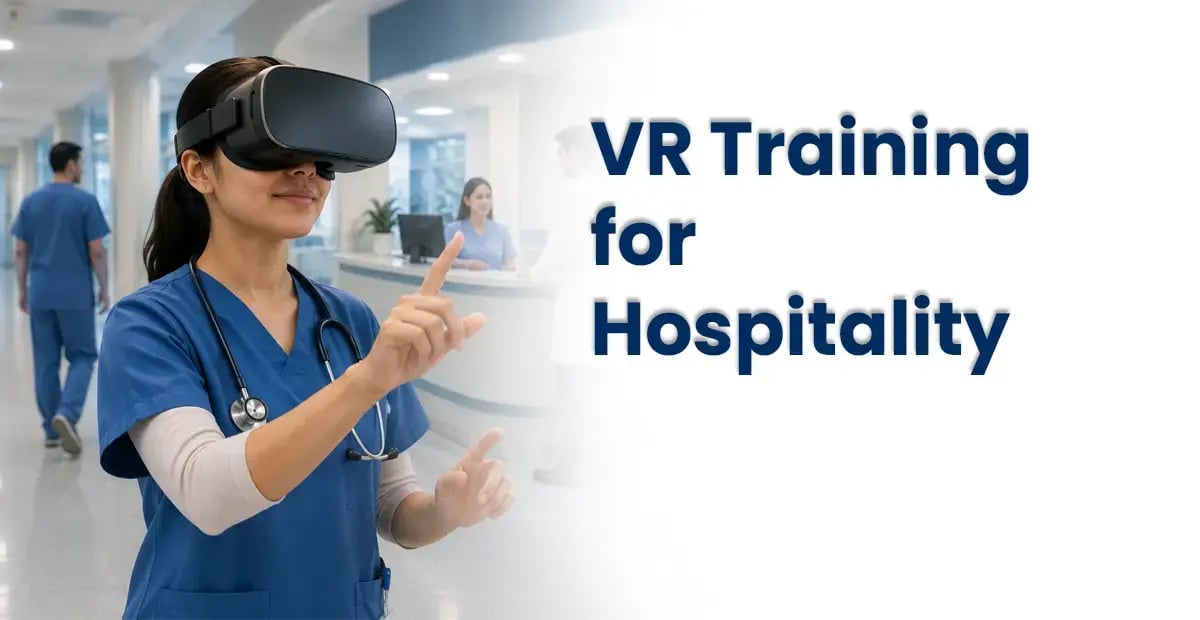

Hospitality is one of the hardest industries to train at scale. Staff turnover in US hotels and restaurants averages 70–80% annually. Properties span multiple locations, languages, and service standards. A guest complaint in Boston should be handled the same way as one in Austin — but with traditional training, it rarely is.
VR training for hospitality solves the consistency problem at its root. Every front-desk associate, F&B server, housekeeping supervisor, and new hire completes the same simulation — the same scenario, the same standard, the same assessment — regardless of which property they work at, which language they speak, or which shift they’re on.
This page covers the specific training scenarios VR delivers for hospitality operations, the measurable outcomes hotel and restaurant groups are achieving, and how our programs integrate with your existing property management and learning systems.
|
8×
faster training rollout across multi-property portfolios
|
+21%
improvement in guest satisfaction score at 6 months
|
|
42%
reduction in onboarding duration vs classroom induction
|
↓24%
staff turnover reduction in year one post-deployment
|
Hospitality training is caught between two competing pressures: the need for consistent, high-quality service delivery across every touchpoint, and the operational reality of chronic understaffing, rapid turnover, and compressed onboarding windows. Traditional training formats resolve neither.
|
🔁
High turnover resets training constantly
US hospitality turnover averages 70–80% annually. Every departing employee takes the training investment with them — and their replacement needs to reach service standard quickly, under time pressure, often during peak season. Classroom programs cannot keep pace with that cycle.
|
🏠
Multi-property consistency is elusive
A branded hotel group cannot guarantee that the service standards delivered by the trainer in Nashville match those in Miami. Guest experience scores reflect this variance — and the brand reputation cost is real. Traditional training quality is inherently trainer-dependent.
|
|
🌐
Language barriers limit training reach
Hospitality workforces in the US are among the most linguistically diverse of any sector. English-only training materials exclude a significant proportion of front-line staff from full comprehension — particularly in safety, allergen, and emergency procedure training where misunderstanding has direct consequences.
|
💬
Soft skills are untestable in classroom formats
De-escalating a guest complaint, handling a difficult check-in, or responding to a distressed traveler are skills that cannot be taught through a slideshow. Classroom role-play is awkward, inconsistent, and rarely reflective of real service pressure. Staff who have never faced a simulated difficult guest will handle the real one unpredictably.
|
Our hospitality VR training programs cover the full guest journey — from check-in through emergency response — with every scenario calibrated to your brand standards, your property layout, and your specific service protocols. Pre-built library modules are available for rapid deployment; custom builds replicate your actual lobby, F&B outlets, and back-of-house environments.
The following outcome data is drawn from Smacar / Yaksha VT hospitality client deployments across hotel groups, restaurant chains, and managed service operators in the US. All figures compare year-two performance against year-zero baseline.
| Outcome metric | Before VR | After VR (Yr 2) | Change |
|---|---|---|---|
| Onboarding duration | 12 days | 7 days | ↓ 42% |
| Guest satisfaction score (NPS) | Baseline | +21 pts | ↑ 21% |
| Staff turnover rate | 38% / yr | 29% / yr | ↓ 24% |
| Training completion rate | 71% | 99% | ↑ 28 pts |
| Complaint escalation rate | Baseline | ↓ 31% | ↓ 31% |
| Annual training cost / employee | $620 | $275 | ↓ 56% |
Hospitality technology stacks are complex — PMS, POS, channel manager, CRM, and LMS all need to work together. VR training plugs into your existing L&D infrastructure via SCORM or xAPI, delivering completion data into the same dashboards your training managers already use — with no new system required.
|
✅ LMS integration
Cornerstone, Saba, Docebo, Moodle, TalentLMS, and all SCORM/xAPI platforms used in hospitality groups. Completion certificates and records appear in your existing compliance dashboard — fire safety certifications, allergen training, and ADA compliance all tracked automatically.
|
✅ Multilingual delivery
English, Spanish, Portuguese, French, Haitian Creole, Mandarin, Tagalog, Vietnamese, and 6 additional languages. Audio narration, on-screen text, and assessment questions all localised. Same content standard across every language — no quality degradation.
|
|
✅ Multi-property deployment
Ship a headset fleet to each property. Every associate at every location completes the same simulation to the same brand standard. Fleet management via MDM — content updates push silently overnight so properties always run the current version.
|
✅ Brand standards embedded
Your service scripts, brand language, uniform standards, and property-specific procedures are built directly into every simulation — not generic hospitality templates. Associates learn your standards in your environment from day one.
|
A regional hotel group with 14 properties across the US Southeast was struggling with a persistent quality consistency problem. Guest satisfaction scores varied by up to 18 points between their highest- and lowest-performing properties — and the variation tracked directly to trainer quality, not property quality. Their existing onboarding program ran 12 days of classroom instruction per new hire, required a dedicated L&D coordinator at each property, and was delivered in English only — despite a workforce that was 40% Spanish-speaking.
|
Before (Year 0)
Onboarding duration12 days
Annual training cost$440,000
Staff turnover38% / yr
Guest sat. variance18 pt gap
|
After VR (Year 2)
Onboarding duration7 days
Annual training cost$195,000
Staff turnover29% / yr
Guest sat. variance4 pt gap
|
The VR program covered five modules deployed across all 14 properties: check-in and service recovery (English + Spanish), fire evacuation, allergen awareness, and housekeeping standards. A rotating fleet of 20 headsets served all properties on a scheduled deployment calendar. For the first time in four years, all 14 properties hit their guest satisfaction target in the same quarter.
We’ll run a VR simulation built for your property type — front-desk service recovery, allergen handling, or fire evacuation — and show you real deployment data from comparable hotel and restaurant groups. 30 minutes. No commitment.
Yes. Once custom hospitality modules are developed in Unity, they can be deployed remotely via a Mobile Device Management (MDM) platform straight to standalone headsets like the Meta Quest 3 across global property clusters. This completely eliminates regional trainer bias and standardizes operational service quality at scale.